
This article was written by Chloe West and Brandon Peluffo, Summer 2026 Interns at Topouria Group in London.
During our time as summer interns at Topouria Group, we found ourselves coming back to two articles over and over again. Taken together, they helped us make sense of the chaos—and opportunity—that characterises geopolitics right now, from the global to the national to the local, even down to our desks inside the startup hub at the London School of Economics.
The first is Parag Khanna’s May 2024 essay “The Coming Entropy of Our World Order.” Two years on, it’s safe to say entropy is no longer coming. It has arrived. Khanna argues that at every level of modern geopolitics, systems trend toward disorder: as time passes, change occurs, energy diffuses, and centralised power shifts through horizontal devolution. This is what we commonly refer to as global fragmentation. In the short term, that means volatility and uncertainty. But disorder also creates the opportunity for reorganisation: self-determination for those previously subjugated, the emergence of regional power centres, new international coalitions, and genuine post-colonial futures.
The second text we’ve been working with is Thomas Friedman’s November 2025 New York Times piece, “Welcome to Our New Era. What Do We Call It?” Where Khanna builds his account of the modern world order on entropy, Friedman uses a different descriptor: “The Polycene.” He traces the same underlying shift through a different lens, and offers a framework for how actors can survive and thrive within it. In the Polycene, Friedman argues, the most resilient and successful organisations will be those that build horizontal connections and inclusive coalitions across sectors—government, business, media, education, and civil society alike.
Together, Khanna and Friedman gave us the analytical frame for research that also informed a strategy consulting engagement for a Topouria Group public sector client: a way of reading the instability of world order as an opportunity to re-position and enhance one’s unique “competitive identity”.
Competitive identity (CI), as conceptualised by the “nation-branding” pioneer Simon Anholt, describes the coordinated use of public diplomacy, trade, tourism, and culture to shape how a country is perceived and trusted on the world stage.
Read alongside Khanna and Friedman, the stakes become clearer: in a fragmenting world order where everyone is competing with everyone else, relationships and narrative matter more than ever. A strong, credible reputation makes everything a country undertakes on the internationally stage easier, and that matters most precisely when new opportunities emerge to build coalitions, assert one’s identity, and help redefine the terms of cross-border engagement.
Although some of the language around CI (“reputation management” chief among it) carries a whiff of superficiality, the framework is actually the opposite. CI treats reputation not as something achieved through advertising and PR, but through the gradual, accumulated experience of people encountering a country through different channels. CI is rooted in consistent, cohesive action: policies, businesses, institutions, communities, and individuals all reinforcing a country’s image and values over time. In this sense, effective CI strategy promotes democracy, transparency, and inclusivity, because it depends on distributed leadership and self-organisation rather than top-down messaging.
Anholt captures this with the “CI virtuous circle”: a country makes progress, which increases its visibility; visibility changes its image; and a changed image supports further positive action, and so the cycle repeats. Anholt identifies six channels through which this happens: tourism, exports, investment and immigration, policy, people and diaspora, and culture.
This article distills our research on four compelling cases of competitive identity strategy: Estonia, Norway, Costa Rica, and Ireland. Despite their varying geopolitical circumstances, resources, and histories, each case reveals the power of Anholt’s framework for countries looking to punch above their weight in a changing global order.
Estonia: “Succeeding at change is our superpower”
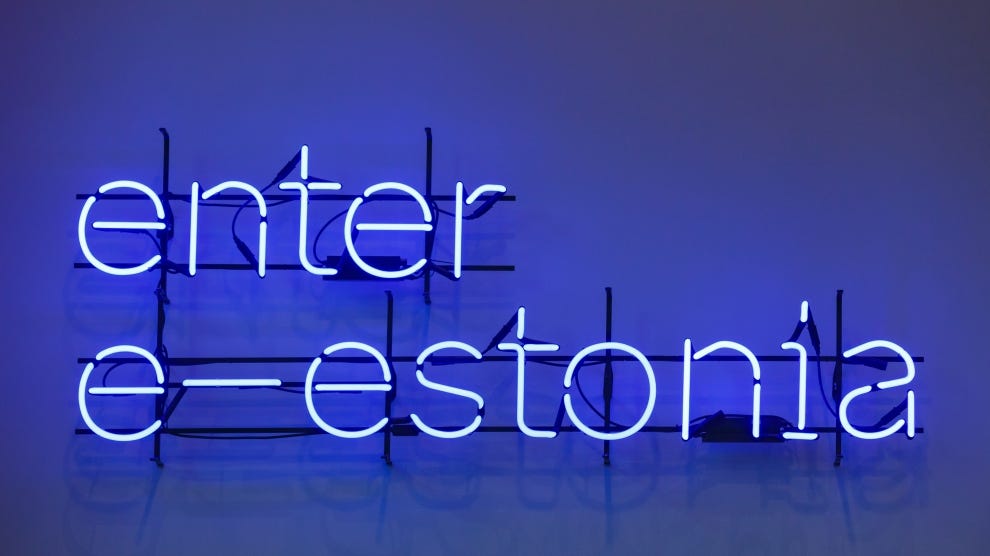
Perceptions of the messenger usually precede the message itself. Thus, the main challenge of Estonia’s public diplomacy was detaching its identity from the toxic perceptions created by the legacy of Soviet rule. After restoring its independence in 1991, “De-Sovietisation” became both state policy and a brand management strategy through which Estonia asserted its westward orientation, aligned itself more closely with its Scandinavian neighbours and their positive associations abroad, and positioned itself as a forward-looking, tech-savvy society.
These measures made change and innovation central to the country’s brand, ultimately producing the national tagline: “Succeeding at change is our superpower.”
Enterprise Estonia (EE) has been the primary engine behind its consistency. In 2002, Estonia hosted the Eurovision Song Contest, backed by infrastructure investment and coordinated promotional campaigns, which gave local businesses a real platform and left visitors curious about the country. EE has since focused on entrepreneurship, helping domestic companies scale internationally, and on propelling Estonia’s digital society: its e-Governance capacity earned Estonia international praise and helped secure the EU’s decision to headquarter eu-LISA, the agency for large-scale IT systems, in Tallinn. The e-Residency programme extends this further, letting entrepreneurs worldwide establish and manage an EU-based company entirely online—a policy that has built a loyal “digital” community among British and Japanese entrepreneurs, in turn validating Estonia’s identity as a serious technology hub. The proof is in the numbers: with a population of just 1.4 million, Estonia has produced more unicorn startups per capita than any other country in the world, a list that includes companies like Skype, Bolt, Pipedrive and Wise.
EE even offers a public access nation-branding guide through Brand Estonia, which gives ordinary citizens the tools and language to represent the country consistently themselves: ”everything you need to speak about Estonia clearly, consistently and confidently.” This digital identity adds a premium to Estonia’s exports: precision goods like electrical equipment and phones benefit from an implicit Nordic country-of-origin effect, connecting Estonian products with an image of ingenuity.
At the same time, Estonia balances its high-tech identity with a softer cultural register, natural beauty, sauna culture, and traditional song and dance. With that, it reinforces its appeal as a place where Nordic, Russian, German, and Baltic influences meet: quiet, friendly, safe, exotic but not too much. The tourist board’s decision to rebrand its spring flood season as a “fifth season” (a natural wonder to canoe through rather than a nuisance to endure) captures this instinct for turning a liability into a defining feature. It worked: both National Geographic and the BBC have covered it as a distinctly Estonian experience.
Finally, Estonia is investing in its diaspora relationship as its population ages and shrinks. Through the Global Estonian programme, the government funds participation in Estonian cultural life abroad, supports professional pathways back to the country, and recognises those who promote Estonian identity internationally, treating the diaspora not as a loss but as a distributed extension of the brand itself.
“Fill your Heart with Ireland”

Ireland’s competitive identity strategy demonstrates the power of integration. Rather than treating diplomacy, trade, tourism, culture, and diaspora engagement as separate, Ireland folds them into a single national narrative, so that progress in one channel amplifies all the others.
The Global Ireland 2025 initiative is the clearest expression of this. Instead of running parallel and siloed campaigns for tourism, trade and diplomacy, the government treats these as interconnected fronts: expanding embassy and cultural-centre presence abroad, deepening ties with the Irish diaspora, and increasing Ireland’s visibility within international institutions all serve one shared identity, captured in the brand line “Fill your Heart with Ireland.”
Tourism is where this integration is most visible to the public. The Wild Atlantic Way doesn’t market individual towns or attractions in isolation; it strings them into a single recognisable route that gives visitors a story to move through, connecting dramatic landscapes to local communities of heritage, food, and hospitality. The result is less a checklist of sights and more a lived narrative of Irish identity.
That narrative travels well beyond Ireland’s borders because of its diaspora. Emigrant communities and people of Irish descent—actors, writers, musicians, entrepreneurs, and political figures alike carry Irish identity into global conversations most small states never reach. St. Patrick’s Day is now a globally recognised celebration; that same familiarity carries through Ireland’s outsized presence in music (Hozier, U2, Sinead O’Connor, The Cranberries) and film (Cillian Murphy, Saoirse Ronan, Paul Mescal, Barry Keoghan, Liam Neeson, Collin Farrell) alongside a literary legacy running from James Joyce and Oscar Wilde to Sally Rooney today. Few countries Ireland’s size achieve this level of familiarity. Even people who’ve never visited readily associate the country with a distinct culture and people. Ireland ingrains this awareness domestically too: the Global Ireland Schools Programme brings diplomats, peacekeepers, and development workers into classrooms to describe Ireland’s role abroad, cultivating the next generation’s stake in the country’s international identity.
The same integration logic extends to Ireland’s economic reputation. Alongside legacy exports like Guinness, whiskey and dairy, Ireland has built a modern identity around technology, pharmaceuticals, and financial services. Ireland has positioned itself as a natural home for multinational investment by emphasising connectivity, skilled English-speaking talent, and as gateway economy into the EU single market.
Ireland ranks 7th on IMD’s Economic Competitiveness Ranking, 5th for attracting talent in the Global Talent Competitiveness Index and 12th on Transparency International’s Corruption Perceptions Index, underscoring that its economic pitch rests on governance credibility as much as talent. Crucially, this modern economic identity doesn’t replace the traditional cultural one, but sits alongside it.
“Essential Costa Rica”
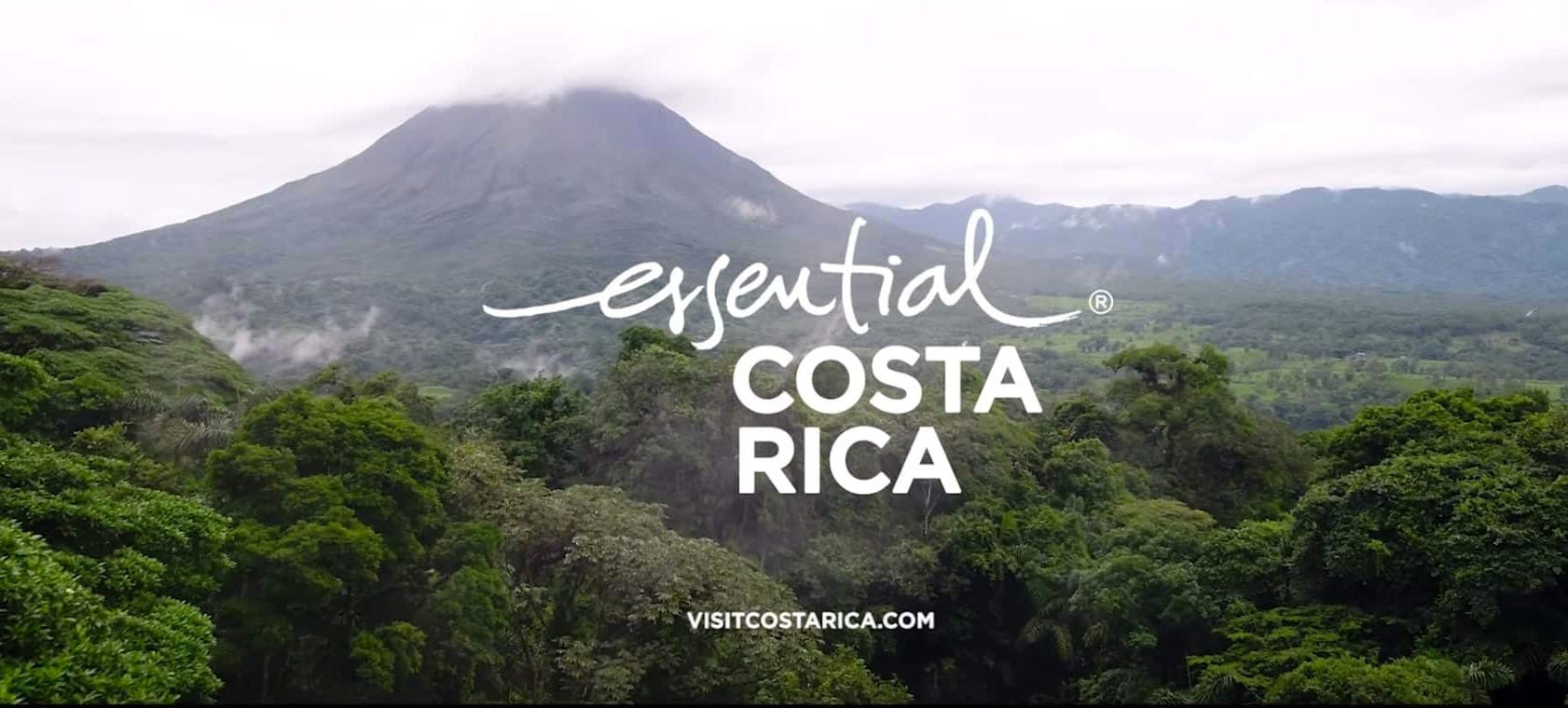
Costa Rica’s competitive identity strategy shows the power of a single idea, communicated consistently across every channel. Costa Rica distilled its identity down to one concept, pura vida—the national ethos of simplicity, contentment, and living well. Then they built the institutional apparatus to carry it into every channel, formalising it under the “Essential Costa Rica” country-brand platform.
The National Parks System, expanded through the 1970s, is where the reality behind that idea begins. Long before “ecotourism” became a marketing term, Costa Rica was protecting vast areas of biodiversity and forest, and its Payment for Environmental Services (PES) programme gave landowners direct financial incentives to conserve rather than clear land, reversing decades of deforestation. This wasn’t a branding strategy, but policy that happened to produce a brandable reality, which is precisely why pura vida could later attach to it credibly rather than as a PR overlay.
Costa Rica then built Essential Costa Rica specifically to carry that idea into every sector at once. Rather than treating tourism, exports, and industry as separate branding exercises, the platform folds them under one certification mark and one shared story: sustainability, social progress, and Costa Rican identity as a single package. In tourism, this shows up as the Certification for Sustainable Tourism (CST), which requires hotels, tour operators, and other businesses to measure and improve their environmental practices, turning sustainability from a marketing message into an operating standard the industry is actually held to. At the export level, the same Essential Costa Rica mark now travels with coffee, agriculture, and manufactured goods wherever they’re sold abroad. Whether a visitor encounters pura vida through a national park, a certified hotel, or a product on a shelf overseas, it’s the same idea, carried by the same institutional platform. Recognition as the World’s Best Wildlife & Nature Destination in 2019, and consistent top rankings among global ecotourism destinations since, reflect an image that matches lived visitor experience rather than outpacing it.
More recently, Costa Rica has extended Essential Costa Rica into a second register. Its Digital Transformation Strategy (2023–2027), building on an earlier 2018–2022 strategy, is modernising government, business, and society through AI, cloud computing, and the Internet of Things, serving as evidence that pura vida, at its core, is really a story about deliberate, values-led development, one that applies as naturally to a data centre as to a rainforest.
The 2024 Environmental Performance Index, where Costa Rica ranks among global leaders, functions as external validation of this whole approach: measurable proof that sustainability is policy, not slogan. Costa Rica also ranks first in Latin America on reputation (RepCore) and 4th globally on the World Happiness Index.
Norway: “We are stronger together”
Norway’s competitive identity strategy places public diplomacy over brand management: in other words, the country’s brand speaks through the actions of their people. The Ministry of Foreign Affairs works alongside organisations like Innovation Norway (the country’s investment and trade agency) to ensure business, government, and other national stakeholders communicate a coherent image of Norway at home and abroad. To accomplish this, Innovation Norway fosters the global reach of domestic business, helps international companies access the domestic market, and provides brand development resources.
Using the Norwegian brand is attractive to domestic companies because it represents wealth, ingenuity, strong governance, and humanitarian leadership. These associations matter even for commodities like oil. In Norway’s oil industry, a strict regulatory climate and mixed development model have fostered institutional competence, technical excellence, and humanitarian leadership. Thus the premium attached to the "Made in Norway" label extends even to a commodity whose reputation elsewhere is anything but clean.
Norway’s success is what Anholt would call a “virtuous circle,” a kind of positive feedback loop: Its Sovereign Wealth Fund illustrates the value of long-term industrial policy and strategic reinvestment over reliance on FDI incentives alone, which is a strategy that, ultimately, attracts FDI anyway. Humanitarian leadership strengthens Norway’s international identity, although immigration continues to challenge the construction of a national identity beyond ethnicity.
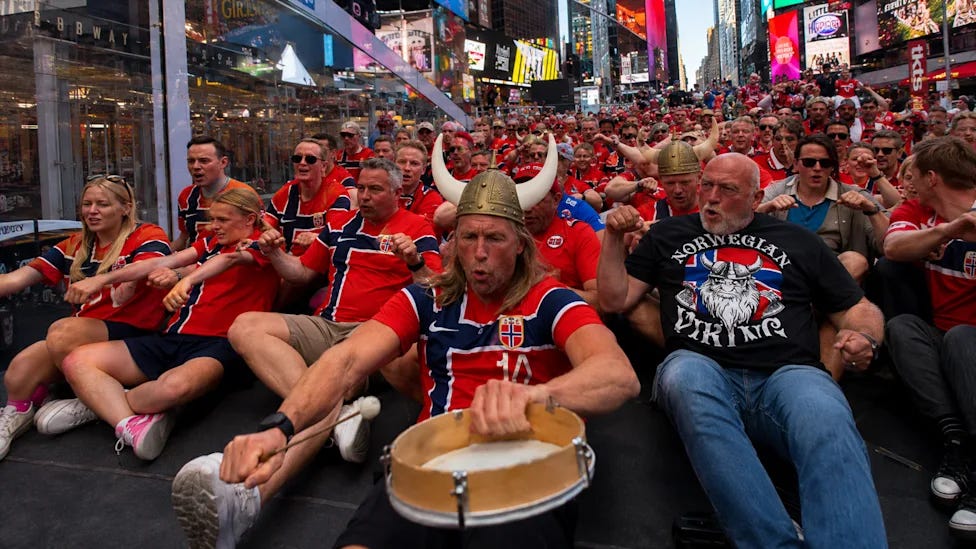
Norway’s cultural diplomacy reflects the same instinct. The country leverages cultural exports—Viking history, folklore—to anchor its diaspora. Nothing has demonstrated this more vividly than the Viking Row, the rowing chant that swept Norway's 2026 World Cup campaign. Conceived by a single fan just months before the tournament, the chant spread from stadium terraces to Boston train stations, Times Square, and even the Norwegian Parliament. It was picked up by opposing fans and eventually featured in the World Cup final's halftime show—a piece of invented tradition that became one of the most recognisable expressions of Norwegian identity on the planet, entirely without state involvement.
What made the Viking Row travel so effortlessly is the same instinct that makes Norwegian culture legible abroad: it draws on imagery the world already associates with Norway. Visit Norway’s initiatives sit on the same foundation: kos, the Norwegian attitude toward cosiness, warmth, and community, is a unique, authentic story about how long winters shape a culture that turns toward connection rather than isolation. Language, dance, and song traditions carry that story internationally through UNESCO recognition, and cultural diplomacy extends it further through art installations worldwide.
Architecture, hospitality, and culinary tradition all revolve around the same relationship to nature, reinforcing Norway’s identity as environmentally conscious and captivating. But the historical imaginary of vast rugged landscapes, Vikings, and native culture packaged into Norway’s folkloric appeal warrants real scrutiny: it trades on ideas of cultural novelty that are not without cost. While the state’s relationship with the Sámi has become more equitable since the 1980s, there is no undoing the exploitation of culture now deeply embedded in Norway’s national identity—a caution for any small state building its brand on indigenous or historical heritage.
Conclusion
The above case studies are where Khanna’s, Friedman’s, and Anholt’s frameworks meet the evidence. If world order really is fragmenting—trending toward the horizontal devolution Khanna describes, or the Polycene’s demand for resilient, cross-sector coalitions that Friedman traces—then Anholt’s “Competitive Identity” offers smaller states a way to turn that instability to their advantage.
A strong reputation cannot replace hard power, but it can extend a smaller state’s visibility, strengthen its diplomatic relationships, and give it greater room to manoeuvre in pursuing its own economic and foreign policy objectives. Estonia, Ireland, Costa Rica, and Norway each show that punching above one’s weight starts with identifying what distinguishes a country, building policies and institutions that reinforce those strengths, and communicating that identity consistently to the world. That reputation opens opportunities well beyond marketing and tourism. Even without the economic scale, military capability, or population of larger powers, these countries can still become the ones others choose to partner with, invest in, and trust.
Chloe West is a junior at the University of California Berkeley, passionate about the intersection of post-colonial history and economic development.
Brandon Peluffo is a senior at the University of California Berkeley, with an interest in political theory and human rights.